
How to Improve Math Test Performance with Smarter Preparation Strategies

Many students think better math scores come from studying longer. In reality, results often improve when preparation becomes more focused, active, and consistent. If you want to improve math test performance, the goal is not to do everything. The goal is to do the right things at the right time.
Math works differently from subjects based only on reading or memorization. You need recall, pattern recognition, logical thinking, and steady practice. A smarter approach helps you build those skills without burning out. It also makes exam preparation feel more manageable.
Why Smarter Preparation Matters in Math
Math tests reward understanding, not just effort. A student may spend hours with notes and still struggle under pressure. That usually happens when study time is passive. Reading formulas again and again feels productive, but it rarely prepares you for real problem solving.
Smarter preparation strategies focus on active recall, spaced review, timed practice, and error correction. These methods train your brain to use knowledge, not just recognize it. That difference matters in algebra, geometry, calculus, statistics, and nearly every other branch of mathematics.
Understanding mathematics requires consistent practice combined with immediate feedback on mistakes. Without feedback students often repeat the same errors across different topics. Using a geometry ai solver allows learners to validate solutions and better understand how each step connects in geometric and algebraic problems. This builds stronger problem solving habits over time.
What Strong Math Preparation Really Looks Like
Good preparation is not about perfection. It is about building a system that helps you practice often, spot weak areas, and improve step by step. Strong math learners do not always feel confident at the start. They simply prepare in a more structured way.
A useful study routine usually includes several connected habits:
- regular review instead of last-minute cramming;
- practice with mixed problem types;
- careful analysis of wrong answers;
- timed exercises that simulate test pressure;
- short sessions repeated across the week.
These habits make studying more efficient. They also reduce panic before the exam because the material feels familiar, not rushed.
Build a Weekly Math Study System
A weekly system gives your preparation shape. Instead of asking yourself what to study each day, you already know the next step. That saves energy and keeps momentum steady.
A Simple Plan for Better Math Test Performance
You do not need a complicated schedule. Most students improve faster when they follow a simple routine and repeat it every week.
- Review new class material within 24 hours.
- Practice a small set of problems on the same topic.
- Mark every mistake and write the correct method.
- Return to that topic two or three days later.
- End the week with a short mixed quiz.
This approach supports long-term retention. It also prevents the common problem of understanding a lesson on Monday and forgetting it by Friday.
How to Turn Mistakes Into Progress
Many students look at wrong answers, feel frustrated, and move on. That wastes one of the best learning opportunities in math. A mistake is not just a wrong result. It is evidence that shows where your thinking broke down.
When you review errors, pay attention to patterns such as:
- misreading the question;
- using the wrong formula;
- skipping a negative sign;
- making arithmetic slips;
- stopping too early in a multi-step solution.
Once you know your pattern, you can correct it faster. Over time, your error log becomes a personal study guide based on your real weaknesses.
Stop Cramming and Start Spacing
Cramming may help with short-term recognition, but math requires more than recognition. You need to retrieve formulas, choose methods, and complete steps accurately. That is hard to do when everything is packed into one late-night session.
Spaced practice works better because it revisits ideas over several days. Each review session strengthens memory and improves speed. Even 20 to 30 minutes of focused work can be powerful when repeated consistently.
A student preparing for a math exam might review quadratic equations on Monday, return to them on Wednesday, and solve mixed problems on Saturday. That pattern trains memory far better than one long cram session before the test.
Use Practice Problems More Strategically
Not all practice is equal. Solving twenty nearly identical questions can create a false sense of confidence. You start to recognize the pattern, but you may not truly understand when to use that method.
A smarter strategy is to mix problem types. Combine easy, medium, and challenging questions. Move between equations, word problems, graphs, and applied tasks. This helps your brain choose the right method instead of relying on habit alone.
Passive Study vs Active Math Practice
The difference becomes clearer when you compare common study habits side by side.
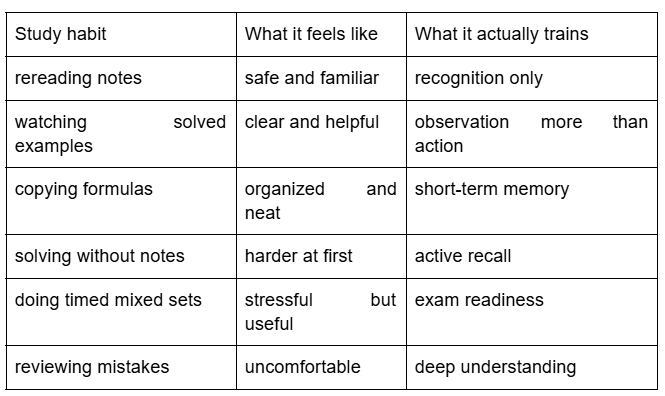
Students often avoid the harder methods because they feel slower. In fact, those methods usually produce stronger results by test day.
Strengthen Memory Without Memorizing Blindly
Memorization has a place in math, but it should support understanding, not replace it. Knowing a formula is useful. Knowing when and why to use it is what raises scores.
Try linking each formula or rule to a type of problem. For example, do not only memorize the area formula. Connect it to diagrams, units, and common traps. The more context you build around a concept, the easier it becomes to recall during an exam.
It also helps to explain ideas aloud. When you teach a method to yourself, you expose weak points quickly. If you cannot explain a step clearly, you probably need more practice with that concept.
Practice Under Real Test Conditions
A major reason students underperform is not lack of knowledge. It is a lack of test readiness. Homework done with unlimited time and open notes does not feel like a real exam. A math test demands speed, focus, and clear thinking under pressure.
That is why timed practice matters. Start small. Set a timer for fifteen or twenty minutes and solve a mixed set without checking notes. Then review both the answers and your pacing.
This method builds confidence because it removes surprises. By the time the real exam arrives, the structure feels familiar. You have already practiced the pressure, not just the content.
Improve Focus Before and During the Test
Preparation is not only academic. Your concentration, sleep, and emotional state also affect performance. Even strong students make careless errors when they are tired or anxious.
A few simple habits can protect your focus on test day:
- Sleep well the night before the exam.
- Eat something light and steady before class.
- Read each problem fully before solving.
- Start with questions you can handle confidently.
- Leave one or two minutes to check signs and units.
These steps may seem basic, but they reduce avoidable mistakes. Often, a better score comes from better control, not harder content.
Manage Test Anxiety Without Letting It Control You
Math anxiety is real, and it can affect students who actually know the material. Stress narrows attention and makes simple tasks feel more confusing. That is why calming techniques should be part of your preparation, not an afterthought.
Breathing slowly for one minute before the test can help. So can writing down a quick formula sheet from memory on scrap paper if the teacher allows it. Some students also benefit from a short reset phrase such as, “One step at a time.” Small routines create stability.
The best long-term solution, however, is preparation that feels organized. Anxiety drops when you know you have practiced, reviewed, and corrected your weak spots.
Final Thoughts on Smarter Math Exam Preparation
If you want to improve math test performance, do not rely on last-minute effort alone. Better results usually come from a smarter system. Review earlier, practice actively, study your mistakes, and simulate real test conditions.
Math success is rarely about natural talent alone. It grows through consistent habits, strategic revision, and calm execution. When your preparation becomes more intentional, better scores often follow. Smarter work does not make math easy overnight, but it does make progress far more likely.


